An independent SeatGeek case study

A better seat.
A clearer decision.

What automated journeys and real people reveal about choosing tickets on SeatGeek.

Read the findings
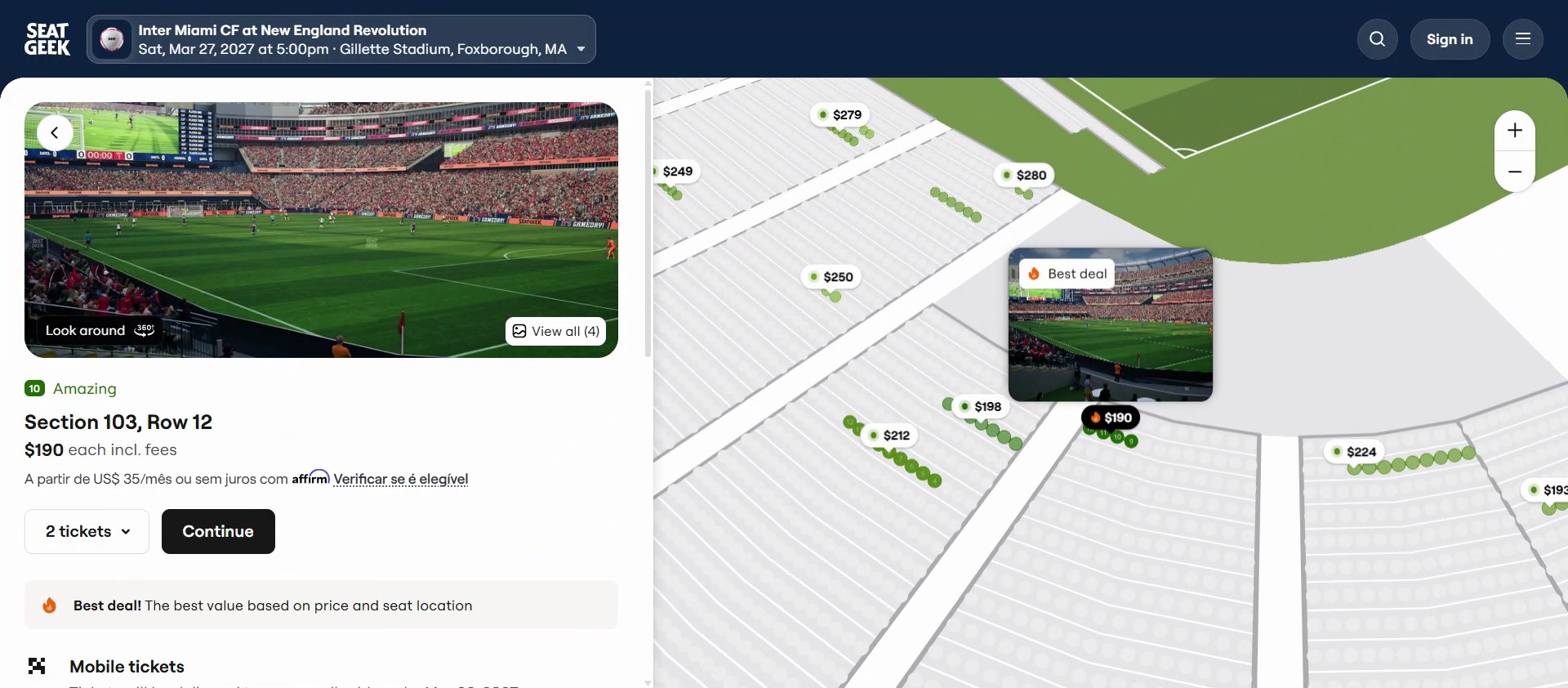
SeatGeek soccer event page in participant P10’s recording, with a two-ticket listing beside the stadium map
The decision in context: P10’s recording at approximately 0:58. Section, price, quantity and view sit beside the map.
8Written responses
8Available recordings
5Countries of residence
12Automated probes + 3 calibration traces

The product question

Can fans tell which ticket
is right for them?

The event page connects a fan’s intent to a seat they feel ready to buy. Choosing well involves price, view, company and the experience they want to have.

I started with automated journeys to identify testable friction, then commissioned a think-aloud study across five countries outside the US. The value is in how the evidence changes the next decision.

Independent exploratory research. No internal analytics. No purchase outcomes. These participants are not verified SeatGeek customers, and country traffic rankings were not independently verified.

Value is personal.
Preserve what helps people choose.

Written responses are mostly positive. They support a focused investigation, with room for different definitions of a good seat.

Written answers · P01, P02, P03, P04, P06, P08, P10

Price and view matter.
The tradeoff belongs to the fan.

Seven of eight answers mention price or view. Those codes overlap; they do not describe one universal definition of value.

“i rather grab a meal with my buddy”

P01 · Netherlands · Written answer

“I could see clearly my favorite player”

P04 · Sweden · Written answer

Product judgment Keep price, section and view context legible together. Test whether a small comparison aid helps fans explain their own choice.

6 of 8 written answers

Most report no comparison concern.

P04 praises the 3D interface. P06 describes section-price comparisons as fair. Preserve those strengths.

Six of eight participants report no comparison concern. This is self-report, not a task-success rate.

Two distinct concerns

Investigate before prescribing.

P08 names pricing; P09 names loading. Neither answer establishes the mechanism, cause or frequency.

A price concern does not prove a fee or currency problem. P09’s verified transcript places the loading complaint after a checkout reference (about 1:49). The destination and cause are unverified; this may be outside the selection task.

See all coded themes, supporting evidence and counterevidence
What the recordings add
Recording review is in progress. Written findings above remain separate from observed behavior.

Evidence library

Hear the reasoning.
Inspect the source.

The same participant connects a recording, a time-linked verified transcript, written answers and a country of residence.

Sharing permission confirmed by the study owner. Recordings are included here for review.

The task participants received

The supplied event was New England Revolution vs. Inter Miami, March 27, 2027. The task asked people to imagine a visit to Boston with a friend, compare a few options and find two tickets. No purchase was requested.

Automation finds states.
People explain decisions.

The human task is not a replication of the automated probes. Agreement needs comparable evidence; a concern going unmentioned is not a refutation.

Automated journeys

October 26–27, 2026

Six synthetic personas, twelve scenario probes and three calibration traces. Useful for reproducing concrete interface states and building hypotheses.

Open the complete automated evidence report ↗

Real participant study

November 5, 2026

Eight participants, each with written responses, a recording and a verified transcript. One imagined ticket-selection task, with varied priorities and incomplete task adherence.

Explore the participant library ↗
How the new study changes the earlier findings
Earlier findingHuman evidenceDecision now
A below-market budget maximum was silently replaced.No comparable below-market filter test in the human protocol. General price sensitivity does not confirm this behavior.Unresolved Keep the reproducible state as a separate fix candidate; verify against the current product.
No accessible inventory needs useful recovery.The human task did not recruit for accessible seating needs or require that filter.Untested Research with affected fans. Do not interpret missing supply as an interface defect.
Party totals may require mental arithmetic.P01 discusses preserving budget for a shared meal. This supports the context of total outing cost, but no arithmetic error is established.Context added Test total-price comprehension without assuming a failure.
What each method can and cannot establish

The automated baseline includes excluded calibration runs, mixed collection protocols, shared-profile limitations and a disclosed ambiguous Continue-area action. The full report preserves these qualifications and original screenshots.

The human sample adds motivations and self-reports. Its small size, imagined task and recording setup limit inference. Neither method measures conversion impact, actual demand or representative country differences. Checkout and attendance remain untested.

Earn the next investment.
Start with a smaller bet.

My recommendation is to protect the existing comparison cues, close the evidence gaps, and prototype one focused improvement before committing to a larger redesign.

1

Verify the problem

Verify task adherence and review the loading episode with P09. Reproduce the budget filter state on the current product. Keep separate explanations open.

Partners: research, engineering and analytics.

2

Test decision clarity

Prototype a comparison of two real listings, retaining price, section and view context. Ask fans to explain their choice and total cost without prompting a specific criterion.

Advance only if people compare more accurately without added effort. Include relevant access needs in a dedicated follow-up.

3

Measure the complete outcome

If usability improves, run an experiment with a predefined population, visitor-level assignment at a common eligibility trigger and a fixed analysis window. Treat checkout entry as a diagnostic, then evaluate completed purchases.

Agree sample size, minimum detectable effect, stop conditions and segment analyses with an analyst before launch.

If the first few days look worse

A comparison aid could increase exploration yet reduce purchases. More clicks would not establish a better decision. I would investigate in this order.

  1. Protect fans

    Check errors and agreed guardrails immediately. A broken purchase path warrants pausing affected exposure without waiting for statistical certainty.

  2. Trust the test

    Validate assignment, sample balance, eligibility, logging and purchase attribution. Compare mature outcome windows and effect uncertainty. Treat rendering failure as a diagnostic, so it cannot disappear from the denominator.

  3. Locate the divergence

    Find the first funnel change, then inspect planned segments: user history, market, platform or app version, calendar date and time since first exposure. Keep the overall result visible; exploratory slices need confirmation.

  4. Test competing explanations

    Use logs, reproduction and user evidence to distinguish bugs, performance, pricing, inventory and promotions. Check competition, weather, seasonality and policy changes too. A shock affecting both randomized groups does not by itself explain their difference.

  5. Decide under the agreed plan

    Pause clear harm, repair invalid measurement, or continue safe uncertainty to the planned analysis. A novelty effect needs evidence by exposure age; it is not a reason to wait indefinitely or extend a test to chase significance.

Turning this study into diagnostic hypotheses
Study signalCompeting explanationsNext evidence
P02 shows one ticket in the sampled frames despite the pair requested.Quantity may be overlooked, or the task may not have been followed. No quantity bug is established.Review the full sequence; test comprehension; compare requested, displayed and handed-off quantities.
P09 reports loading after a checkout reference.A handoff, asset, connection or device issue may interrupt progress. The destination and cause remain unverified.Locate the episode; inspect timing, errors and the actual stage under documented device and network conditions.
P01 reserves money for a meal instead of a modest view upgrade.A useful comparison may help fans express their own price–view tradeoff. This does not establish a willingness-to-pay segment.Test choice explanation and total-cost comprehension while preserving price, section and view context.
Automated traces record a silently replaced budget maximum.Filter state may fail to preserve budget intent. The human task did not test this state.Reproduce on the current product; compare requested, applied and displayed bounds before choosing a fix.

At the decision point, ship only if the mature purchase outcome meets the prespecified benefit rule and guardrails pass. Stop credible harm; call unresolved uncertainty inconclusive. These are proposed diagnostic steps, not results from an experiment run in this study.

Experimentation references

Microsoft: diagnosing sample ratio mismatch · Microsoft: trustworthy experimentation during a test

The limits belong
beside the findings.

Five residence countries: two participants each from the Netherlands, Brazil and Sweden, and one each from Italy and the UK. Recruitment allocation is not traffic weighting. “Top five outside the US” is the study owner’s recruitment rationale; traffic analytics were not supplied.

Eight responses join uniquely to eligible demographic rows. Returned submissions with revoked consent are excluded. The site shows residence only, with anonymous participant labels.

Full evidence and interpretation limits